
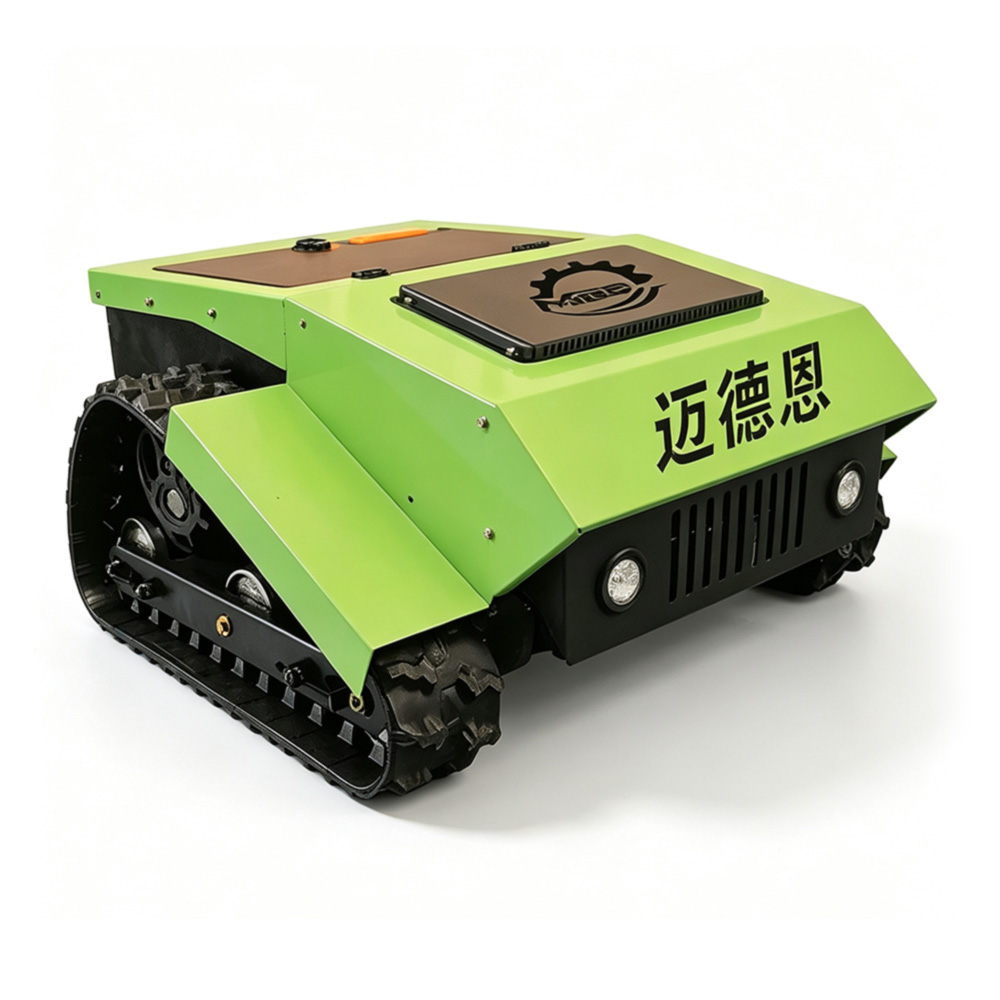
Many overseas farm owners and greening contractors hesitate between fuel-powered and battery remote tracked mowers. Neither option is universally better. The right choice depends on working patterns and site conditions to get the best value. Based on long-term feedback from global users, Maideen sorts out the key differences for easy reference.
Fuel remote mowers feature outstanding continuous runtime. A large fuel tank supports long-hour nonstop operation, ideal for large photovoltaic sites, long river embankments and mountain pastures. When tackling thick weeds and tough brush, fuel engines deliver steady high torque with strong load capacity. They perform reliably in cold weather with limited power loss. On the other hand, fuel models require regular fuel system maintenance, fuel storage, and produce exhaust and noise during operation.
Battery-powered mowers are clean and easy to operate. Once fully charged, they are ready for work without fuel supply and storage. They fit small and medium orchards, suburban green spaces and sites near residential zones. Low noise allows flexible scheduling in noise-restricted areas. The simplified structure cuts daily maintenance work, which is friendly for new operators. The main limitation is battery life. Extra batteries are required for large-area continuous work, and cold temperatures reduce battery working duration.
Maideen’s fuel and battery remote mowers share the same tracked chassis, remote control module and cutting assembly. Climbing performance and anti-tangling design stay consistent. Buyers can make decisions based on working area, location and local environmental rules. For remote, large-scale wild vegetation management, fuel models are preferred. Battery versions work better for small nearby sites with noise and emission limits. Matching the power type to your workflow helps the remote mower serve reliably for years.
 +852 5462 5594
Click the icon to open WhatsApp
 86 185 5376 3333
Scan to add WeChat